more on perspective

courtesy of vitamin z, here is something that I have thought of before from Chris Brauns, Unpacking Forgiveness: Biblical Answers for Complex Questions and Deep Wounds

“If we begin to get a glimpse of the vast glory of God, we will realize that many of our conflicts are like two ants arguing about which is taller while standing in front of Mount Everest.

“We quibble over some infinitesimal difference of opinion while the vastness of Almighty God soars into the heavens.

“We need to stop looking at one another relative to ourselves, or, better yet, stop looking in the mirror. And we need to turn our eyes to the loveliness of Christ in his Word.”

Of course I have thought of it more like us living in Who-ville thinking we are really all that, while in reality we are nothing more than a speck of dust on God’s lapel.

And then I think that even though we are truly infinitesimal in the grand scheme of things, God reached down in love to reconcile us to Him even at the cost of His own Son.

If He would do that for us, then surely we can forgive those who trespass against us.

Posted in teaching | Tagged , , , , | Leave a comment

singing my song

Joe Thorn is singing my song. I love to sing and I firmly believe there is a song for every occasion. Singing is a wonderful way to express thoughts, fears, feelings, hopes, concerns, dreams. Sometimes when no song lyrics come to mind, I will make them up. My kids feel like they live in a musical sometimes.

here’s a bit of Joe. be sure and read the rest to see his suggested remedy when you don’t feel like singing.

People sing about the things that capture their hearts, things that give them joy, or allow them to express sorrow. People sing of heroes, victory, longing, and hope. Does anyone have more reasons to sing than you? As a sinner who has been forgiven, a slave who has been set free, a blind man who has received sight, a spiritual cripple who has been healed – all by the gospel, you have real reasons to be known as a man of song!

Posted in music | Tagged , , , , | Leave a comment

modern fatherhood

Dr. Mohler hits a glancing blow at something that really bothers me about the way fathers are portrayed in current popular culture.

Fatherhood has been marginalized and the rule and authority of fathers have been depreciated, ridiculed, and continuously redefined. From the Berenstain Bears to The Simpsons, fathers are all too often the object of ridicule or the subject of the laugh line.

I hate that the dad is always the clueless out of the loop buffoon. I like playing the clown for my kids and making them laugh, but I resent having to compete with a dominant cultural view of my role that says I don’t have anything useful to offer the family except being the last one to know whatever is going on.

That is one of the reasons that I like the show Hannah Montana. Billy Ray Cyrus has elements of the out of the loop buffoon in his character, but he always ends up knowing more than the kids thought he knew about what was going on. He provides wisdom and comfort when they need it, discipline when they need it and generally makes them obey him.

Dr. Mohler attributes the cultural marginalization of fatherhood to feminism and I think he is correct.

The marginalization of fatherhood can be traced to many developments, but one prime source of this marginalization is the intellectual class and its radical commitment to ideological feminism. Fatherhood is now an ideological category that is inescapably linked to everything from patriarchy (considered to be the original sin) to popular culture (where the intellectual elites exert a very significant, if indirect influence).

Dr. Mohler then spends some time looking at an article by Bradley Wilcox dispelling modern myths of fatherhood and concludes with this reminder:

Christians have a special stake in this argument, for we believe that fatherhood is not just a social construction but a matter of biblical importance. Though informed by sociological analysis and encouraged by academics like Bradford Wilcox, our confidence in the role of fathers is based in the fact that fatherhood is a role that is honored, dignified, and defined in Holy Scripture. The Christian father is answerable to a far higher calling, but the data surveyed in Brad Wilcox’s essay serve as a reminder that fatherhood is a gift to all creation and that the evidence of the Creator’s design for fatherhood defies all the ideological efforts of so many to subvert fathers and fatherhood.

Posted in culture, teaching | Tagged , , , | 3 Comments

accountability

My sister sent me a link to this open letter to pastors on the importance of recognizing danger and taking steps to avoid it. Although it is addressed to pastors, it applies to everyone. If you care at all about avoiding a shipwrecked life and ministry, take the time to go read the whole thing.

here is sample:

I do, however, want to comment on pastors shipwrecking their lives and the lives of their families. I have been involved in ministry all of my life, the past 27 as a staff member or pastor at three different churches, and I have seen stories like Gary’s over and over. The details vary, but the end result is the same; total devastation. The key question is not what happened, but rather how can we avoid the same fate. Here are some random thoughts:

1. If you think you aren’t vulnerable, you are already toast
I had a counseling professor in college who said that the pastors who are in the most danger of a moral shipwreck are the ones who think it will never happen to them. If you think you are too honest, too faithful, or too transparent to ever be involved in an affair you are skating on very thin ice. David never thought he’d sleep with Bathsheba until he saw her naked; then he couldn’t think of anything else. You can steal money, you can get involved in pornography, you can cheat on your spouse, and you can lie to your family. Every day of our lives we have to remind ourselves we are vulnerable to complete moral failure.
…..
You don’t wake up one day and decide to shipwreck your life. You do it one stupid decision at a time. As someone who has seen this happen again and again and again I am begging you to take action today because it will happen to you.

Posted in teaching | Tagged , , , | Leave a comment

photo phriday

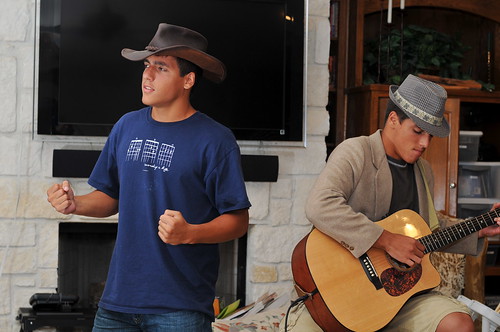
here are my sister’s sons hamming it up. I had one flash to camera left and one mounted on the camera bouncing off the white ceiling. Both set to TTL.
Nathan and Joshua

here is the picture from which I cropped my current header.
morning clouds

and a snap from the trip home yesterday evening while I waited at a stop light.

afternoon

Posted in photography | Tagged , , , , , , , , , | Leave a comment

iPhone 3.0 OS update

I have spent an evening with the updated operating system for my first generation iPhone. I must say that I really like it and I wonder why they couldn’t have done some of these things from the get go.

I can’t tell you how many times in the last year and a half I have turned the phone sideways on email trying to get slightly larger font to read and the bigger key board. Now that it is here, what can you say except: ahhhhhhh! finally.

cut and paste seems to work pretty well. that ought to help with the mobile blogging, but not much of that going on anyway, so not that big a thing. I hear that the twitterers among us are very excited about it though. Maybe now that it is possible, I will find it more useful than I think, but there have been very few times that I have wanted to be able to copy text on my phone.

I love stock charts and I am glad there is more information available on the built in stocks application. again, though, this is something that should have been available a long time ago.

I still want to upgrade to the 3G S for the better camera, increased storage, and video. But that will have to wait for funds to aggregate. In the meantime, this OS upgrade is very much appreciated.

Posted in tech | Tagged , , , | Leave a comment

learning vicarious suffering

courtesy of vitamin z, I saw this quote from Tim Keller:

“You need to get used to this reality. Once you become a parent, for the rest of your life, you’ll never be happier than your unhappiest child, because your heart is tied to your kids. That is a way of learning the gospel because before you have kids you don’t really know what it means that God suffers for your sins. He has to. He has to suffer for your sins, because when you have children you suffer for their sins. Your heart is tied up to them.”

Posted in family, teaching | Tagged , , , , | Leave a comment

Worship CD from Austin City Life

Austin City Life will release its first worship CD on June 28. Here is their myspace page where you can preview the tracks.

here are some of the distinctives of ACL’s approach to music:

City focused
Gospel-centered
Martin Luther on the Spirit
High Colossian Christology
Ancient hymns to progressive tunes
Reflective worship that builds and crescendos
Integration of Gospel, Community, and Mission in the song writing

nate navarro is one of the three worship leaders and he already has music out.

Keep in mind that Jonathan Dodson is firmly of the opinion that God is not your girlfriend or boyfriend.

Posted in music | Tagged , , , , | Leave a comment

iPhone OS 3.0

today is the day for the OS update release. This is the page for download.

Nothing yet.

Posted in tech | Tagged , , | Leave a comment

new page

I took a post from last August and elevated it to its own page. Check it out sometime.

Posted in culture | Tagged , , , , , | Leave a comment

different perspectives

Todd Bumgarner has posted a contrast in perspectives:

“If you will keep the right attitude, God will take care of all your disappointments, broken dreams, the hurts and pains, and He’ll add up all the trouble and sorrow that’s been inflicted on you, and He will pay you back with twice as much peace, joy, happiness, and success.”

–Joel Osteen, Your Best Life Now (New York, NY: Faith Words), p 77.

Now, contrast that with Jesus’ words to Paul in 2 Corinthians 12:7-10:

“My grace is sufficient for you, for my power is made perfect in weakness.”

for further comparison, if you have some time, check out these verses that I collected in response to a question:

Mt. 10:37-39; Mt. 16:24-28, Mt. 18:2-4; Mk. 2:17, Mk. 8:34-38; Mk. 10:42-45; Luke 9 esp v. 23-27, 46-48 and 57-62; Lk. 14:25-33; Lk. 21:1-4; Jn. 2:24-26 and Jn. 15:18-21.

Posted in teaching | Tagged , , , , , | Leave a comment

the most thorough car road test ever

here is the most thorough car road test ever. Top Gear knows how to do it. just keep watching

[youtube=http://www.youtube.com/watch?v=h_KIqdS1SO0&hl=en&fs=1&]

Posted in humor | Tagged , , , | Leave a comment

learning someone else's lessons

John Mark went to the Advance 2009 conference where the topic of hero worship of celebrity pastors came up. John Piper and Kevin DeYoung have some thoughts about “celebrity pastors” in our current environment. There is a very interesting and thin line between appreciating, learning from, admiring, seeking to imitate on the one hand and an improper adulation on the other hand.

We are very blessed to live in an age when you can sit down anytime anywhere and listen to your choice of some of the most talented communicators on the planet expound on God’s Word. I love it and I partake of it.

But, in this environment it is essential that every one of us cultivate our own relationship with the God of the universe first. Our priority has to be on learning what God has to teach us directly from His Word on our own with only the Holy Spirit to mediate the exchange. As partakers of the New Covenant, we are the beneficiaries of this wonderful reality:

….I will put my laws into their minds,
and write them on their hearts,
and I will be their God,
and they shall be my people.
11And they shall not teach, each one his neighbor
and each one his brother, saying, ‘Know the Lord,’
for they shall all know me,
from the least of them to the greatest.

quoting Jeremiah 31:31-34

Jeff Mangum has just completed a two week look at the art of self-feeding. I am hoping that part two will be put up on iTunes today. What Jeff did was just go through a time of personal study to show everybody how easy it is and how productive it can be. It was just a very nuts and bolts look at how anyone from a sophisticated seminary graduate to a 12 year old boy and everybody else can REAP (Read the Bible, Examine it, Apply it and Pray for God’s help in following through with remembering the lesson and application).

It is absolutely critical that we engage directly with God through the Bible and learn from Him what He wants to teach us.

As a nice (and probably necessary as well, but that should be the subject of another post) supplement, there is a whole world wide web of other teaching and resources. I believe that we will have a better chance of keeping our perspective with regard to other human teachers in order to avoid hero worship if we first have learned for ourselves what God Himself seeks to teach us directly.

Posted in culture, teaching | Tagged , , , , , , , , , | Leave a comment

faster please

Jonah Golberg has been the lone voice crying in the wilderness on behalf of proper funding levels for research into airborne-laser volcano lancing.

The only thing I can do at this dire moment is to add my small voice to Jonah’s and beg for more funding of this important project before it is too late. Faster please.

from New Scientist here is more on the possibly impending threat.

If the structure beneath the three volcanoes is indeed a vast bubble of partially molten rock, it would be comparable in size to the biggest magma chambers ever discovered, such as the one below Yellowstone National Park.

Every few hundred thousand years, such chambers can erupt as so-called supervolcanoes – the Yellowstone one did so about 640,000 years ago. These enormous eruptions can spew enough sunlight-blocking ash into the atmosphere to cool the climate by several degrees Celsius.

Could Mount St Helens erupt like this? “A really big, big eruption is possible if it is one of those big systems like Yellowstone,” Hill says. “I don’t think it will be tomorrow, but I couldn’t try to predict when it would happen.”

Posted in humor | Tagged , , , , , , | Leave a comment

hypocrisy

Last night I had a mental block and couldn’t think of the saying “hypocrisy is the tribute that vice pays to virtue.” I got past the mental block and made the point that I wanted to make without the saying.

I thought of it on the way home, but then I wondered where it came from. According to this fellow, it came from La Rochefoucauld and was originally “Hypocrisie est un hommage que la vice rend à la vertu.”

While I was there, I read the guy’s page “in defense of hypocrisy” and it made the point that I was trying to make last night very well indeed.

The hypocrite, while choosing vice, recognizes that virtue is in fact better, if not for him, and assumes its appearance. When we characterize the hypocrite as dishonest, we must recognize what he is dishonest about: not about good and evil, but only about himself.

Teenagers are very sensitive to hypocrisy, especially in their parents, their teachers, and any other figures in authority. As one facing the teenage years a second time—this time as the father of a teenager—I am becoming very aware of this. No doubt this sensitivity comes from a perception that these persons in their lives are not, after all, perfect. Yet they continue to insist upon high standards of behavior from the young person. They tell you to keep your temper, and then lose theirs; they tell you to obey traffic laws and then get stopped for speeding; they profess a religion, but then don’t live as if it made any difference. When I was a teenager, we were fond of pointing out anything of this kind that we could discover (and I couldn’t discover much).

When a teenager or an adult discovers hypocrisy of this sort in another person, particularly one claming authority, the first reaction is to reject the authority. If Dad says I shouldn’t drive too fast, but he drives too fast, then he must be wrong about speeding, so I’ll do it too. If they tell me not to drink, but then they get sloshed on a Saturday night, well, I guess I can do it too. The parents may be hypocrites in fact, and since the average teenager does not have the sophistication of a French noble of the age of Louis XIV, he does not realize that his parents at least recognize what is right, even if they prefer not to do it.

On the other hand, they may be fallible human beings who want to do what’s right, but feel compelled to do otherwise. Cowardice or anxiety or the heat of emotion can overpower anyone and lead to choosing what we know to be wrong. We live in a constant state of moral tension between what we know to be right and what we actually find ourselves doing, and the confused standards of those who would exploit our precarious situation to increase their own wealth or power does not make the situation any more secure. A person who behaves contrary to his professed principles may merely be struggling—or he may be a hypocrite.

Posted in teaching | Tagged , | Leave a comment

Religion v. the Gospel

helpful reminder and summary. here are some to get you started, but please do go read all of them.

RELIGION: I obey-therefore I’m accepted.

THE GOSPEL: I’m accepted-therefore I obey.

RELIGION: Motivation is based on fear and insecurity.

THE GOSPEL: Motivation is based on grateful joy.

RELIGION: I obey God in order to get things from God.

THE GOSPEL: I obey God to get to God-to delight and resemble Him.

RELIGION: When circumstances in my life go wrong, I am angry at God or my self, since I believe, like Job’s friends that anyone who is good deserves a comfortable life.

THE GOSPEL: When circumstances in my life go wrong, I struggle but I know all my punishment fell on Jesus and that while he may allow this for my training, he will exercise his Fatherly love within my trial.

RELIGION: When I am criticized I am furious or devastated because it is critical that I think of myself as a ‘good person’. Threats to that self-image must be destroyed at all costs.

THE GOSPEL: When I am criticized I struggle, but it is not critical for me to think of myself as a ‘good person.’ My identity is not built on my record or my performance but on God’s love for me in Christ. I can take criticism.

RELIGION: My prayer life consists largely of petition and it only heats up when I am in a time of need. My main purpose in prayer is control of the environment.

THE GOSPEL: My prayer life consists of generous stretches of praise and adoration. My main purpose is fellowship with Him.

Posted in teaching | Tagged , , | Leave a comment

more czars than the Romanovs

here is a helpful list of all of the executive branch offices meddling without congressional assistance directly into our lives. Almost all of these have been put in place in the last five months.

The wheels are off the wagon. I was going to sensibly advocate against this outrageous growth in government and its control over the free enterprise of America. But then I saw some commentators say it didn’t go far enough, and throw around words like ‘accountability.’ We are living in scary times, when a few people with oligarchic intentions can so easily take control over the fundamentals of capitalism, freedom and enterprise. And they deliver these big government measures and czars with promises of “restraint.” Have you ever trusted the federal government to show “restraint.”

President Obama has a Pay Czar, Border Czar, Energy Czar, Urban Czar, Tech Czar, Faith Based Czar, Health Reform Czar, TARP Czar, Drug Czar, Stimulus Accountability Czar, Non-Proliferation Czar, Terrorism Czar, Regulatory Czar, Guantanamo Closure Czar, AIDS Czar, Weather Czar, Intelligence Czar, Economic Czar, Green Jobs Czar and Cybersecurity Czar. I’m not making any of that up! All of these people report directly to the President, and most of the new positions expand government’s reach into the American daily life to a troubling extent. Up until the 1950’s the President had nine cabinet officers. Now we have nearly 50 (fifty!) people directing their own corners of government. As John McCain said, even the Romanovs who ruled Russia for 3 centuries only had 17 czars. This is madness.

emphasis added.

This is indeed madness.

hat tip to Jennifer Rubin who adds:

Cooper raises a valid point: it is not just that we’ve had an enormous expansion of power by the federal government, it is that it has been done with virtually no Congressional consent, funding, or oversight. Liberals were very concerned about an imperial executive in the era of George W. Bush but nary a peep now is raised when Congress becomes a mute bystander. Conservatives don’t like the expansion of federal power, the erosion of the rule of law, the attack on the free market and irresponsible spending — but they should be alert also to the grave constitutional distortion underway. Congress may not be to conservatives’ ideological liking but at least there the minority’s voice is heard in the Senate, debate and compromise can take place, and there is the opportunity for public opinion to register. Government by executive fiat contains none of those protections.

Posted in politics | Tagged , , , , , | Leave a comment

mega church research

Catalyst has posted some research findings related to the attenders of mega churches. Go to the their post for links to the source material, but here are the findings that Catalyst posted.

fascinating:

Nearly two-thirds of megachurch attenders are under 45 years old, as compared to only one-third for all protestant churches (62 percent vs. 35 percent).

Nearly a third of megachurch attenders are single, unmarried persons. In a typical church, singles account for just 10 percent of the congregation.

Megachurch attenders are both more educated and more affluent than attenders at other churches.

The majority of megachurch attenders are not necessarily new to Christianity, but nearly a quarter had not recently been in another church before coming to a megachurch.

While newcomers almost always attend a megachurch at the invitation of family, friends or co-workers, the real attraction tends to be the church’s reputation, worship style and senior pastor.

Long-term attendance flows from an appreciation for the church’s music/arts, social and community outreach, and adult-oriented programs.

45 percent of megachurch attenders never volunteer at the church.

Posted in church | Tagged , , , | Leave a comment

marriage links

Jonathan Dodson has a great roundup of links to marriage resources. Go check them out.

Posted in books, family | Tagged , , | Leave a comment

foto friday

here is bokeh from the 105mm on Film
Happy Bokeh Wednesday F4e

and Joseph is back out at Camp Peniel for two weeks of work camp. This is the shower and sink facility
camp peniel F4e

and here is some lightning from last night’s storm. This was my first attempt at lightning capture. I want to have another go at it.
tonight's storm

Posted in photography | Tagged , , , , , , , , , , , , , , , | Leave a comment

pray believing

Challies has a great essay up about Acts 12 and you should go read it.

I particularly liked this part because it so accurately reflects the common human experience.

Despite the miraculous (Peter being rescued, Herod being struck down) there is such a human element to it. We see the church in prayer, undoubtedly begging God for the life of their friend and pastor Peter. Yet when God answers their earnest prayers, they refuse to believe it. “You are out of your mind,” they told Rhoda when she tried to tell them that God had answered them. Two thousand years later we laugh at them, wondering why they would bother praying if they did not think God would bother to answer. And then we realize that we do little better; we realize how much effort we put into pleading for God to act and how little effort we put into seeking answers to those prayers. I trust the lesson was not lost on the early church. I trust they learned from it that God’s miraculous rescue of Peter was not in any way separate from their prayers. Those prayers, offered as they were even with little faithful expectation of an answer, were undoubtedly instrumental in God rescuing Peter from his imprisonment. God answers prayer, even when we ask with little faith.

here it is in the Bible:

12When this had dawned on him, he went to the house of Mary the mother of John, also called Mark, where many people had gathered and were praying. 13Peter knocked at the outer entrance, and a servant girl named Rhoda came to answer the door. 14When she recognized Peter’s voice, she was so overjoyed she ran back without opening it and exclaimed, “Peter is at the door!”

15″You’re out of your mind,” they told her. When she kept insisting that it was so, they said, “It must be his angel.”

16But Peter kept on knocking, and when they opened the door and saw him, they were astonished.

so, they are praying for it. Rhoda tells them that there prayers were answered. They were still astonished to see Peter when they opened the door.

How very much like us that is.

Posted in teaching | Tagged , , , , , , , | Leave a comment

moral decision making in America

Dr. Albert Mohler takes a look at President Obama’s declaration of June as gay, lesbian, transgendered, bisexual month. Along the way Dr. Mohler states his background assumption with regard to moral decision making by most people in this country:

Most Americans come to moral judgments by a complex and often confused process that combines moral intuition with emotivism and some (often quite minimal) knowledge of the history of moral judgment. Add to this the fact that most Americans are highly influenced by popular culture and mass opinion. In the end, as many observers have argued, most Americans are probably moral pragmatists at heart.

On an issue as controversial as homosexuality, moral confusion abounds. Americans respond to questions related to homosexuality with a range of often inconsistent and contradictory moral judgments. Ask a question about same-sex marriage one way and you get one answer. Change the question slightly, and you might get a very different response from the very same person.

moral pragmatists is exactly the right term to cover morality today in this country.

oh yes, and one other word from Dr. Mohler’s essay, just to remind us how things get heard:

Morally serious persons must take the President’s proclamation as a morally serious act. As such, it demands a response. Evangelical Christians dare not respond with a claim of moral superiority as if we are not ourselves sinners. But we must be clear that we cannot find pride in sin, whether these are our own sins or those of others. The Gospel of Christ simply does not allow us to see sin — any sin — as a matter of pride.

emphasis added.

when this issue comes up, we have to put it in the context of our own and universal sinfulness. We are all bent. We are all sinners. No sin is worse than any other. All of us have to rely on God’s grace for reconciliation with Him. None of us have any priority or preference over anyone else.

Posted in culture, politics, teaching | Tagged , , , , | Leave a comment

Free will of the wind

I downloaded and listened to this sermon last week. Powerful explication of John 3:8. listen to, watch or read the whole thing.

So the point so far is that the wind is mysterious. It has a will of its own, so to speak. It comes and it goes by its own laws. We don’t control it. We didn’t then. And we don’t now 2,000 years later. The wind is free. We do not decide what the wind does. The wind does what the wind does.

The Decisive Act—The Wind’s, Not Ours

Then Jesus makes the comparison with the Spirit’s work explicit. Verse 8: You have heard how the wind works . . . “so it is with everyone who is born of the Spirit.” Literally: “In this way is everyone who is born for the Spirit.” You have heard how the wind works . . . “in this way everyone who is born of the Spirit comes into being.” The point of emphasizing the freedom of the wind in producing its effects is to make plain the freedom of the Spirit in producing people who are born again.

So what verse 8 is teaching is this: We don’t cause the Spirit to bring about the new birth any more than we make the wind blow. Or to be more specific, the decisive act of will in the new birth is not ours. The Spirit’s will is decisive. To be sure, our will moves in the moment of the new birth. Change happens in us. There are perceptible effects of the wind—“ you hear its sound.”

The main effect of the wind—the Spirit—is that we are made alive spiritually—born again—and now our wills move. They move to receive Christ and believe on Christ. But our wills move because the wind is blowing, not the other way around. We don’t move first. Our wills are awakened and moved toward Christ because the Spirit blows where he wills and gives life to whom he wills.

Posted in teaching | Tagged , , , , | Leave a comment

Piper's journey

Here is a sermon where John Piper talks about his journey as a scholar and pastor. Fascinating. Here is a small snippet, but the whole thing is very interesting indeed.

The synthesis of mind and heart was embodied in C. S. Lewis. Lewis became for me in my college days what Jonathan Edwards became in my seminary days. He was a “romantic rationalist”—that was the name of a small book about Lewis that that got me very excited because it summed up what I thought I was (which may be very akin to “pastor-scholar”). Lewis has had a tremendous influence on me in several ways.

Lewis embodied the fact that rigorous, precise, penetrating logic is not inimical to deep, soul-stirring feeling and vivid, lively—even playful—imagination. He combined what almost everybody today assumes are mutually exclusive: rationalism and poetry, cool logic and warm feeling, disciplined prose and free imagination. In shattering these old stereotypes for me, he freed me to think hard and to write poetry, to argue for the resurrection and compose hymns to Christ, to smash an argument and hug a friend, to demand a definition and use a metaphor.

Lewis was the main influence on Clyde Kilby. And so he had the same effect on me. He gave me an intense sense of the “realness” of things. To wake up in the morning and be aware of the firmness of the mattress, the warmth of the sun rays, the sound of the clock ticking, the sheer being of things (“quiddity” as he calls it). He helped me become alive to life. He helped me see what is there in the world—things which if we didn’t have, we would pay a million dollars to have, but having them, ignore.

Finally, he has made me wary of chronological snobbery. That is, he has shown me that “newness” is no virtue, and “oldness” is no fault. Truth and beauty and goodness are not determined by when they exist. Nothing is inferior for being old, and nothing is valuable for being modern. This has freed me from the tyranny of novelty.

Posted in church, culture | Leave a comment

mysticism

Kevin DeYoung takes a look at mysticism. What it is, where it can lead and why it is dangerous.

go read the whole thing, but this is how he ends it:

The pattern has been repeated many times. People start to pay less and less attention to Scripture, saying it has errors or it can’t be understood or it’s less spiritual than the Spirit within us. Exuberance, courage, and activity follow as people feel alive and less shackled by “tradition” and fixed propositions. With their new found inner truth, these people grow dissatisfied with sermons, notions of authority, and Church-as-we-know-it. More exuberance. But eventually the excitement wears off. The activity dies down. What’s left is the internal Word, which, it turns out, is no different from our own opinions, convictions, and desires.

Without an outer, objective Word, the internal Word always gives way to rationalism, because in appealing to our inner sense of things, we end up just appealing to our own reason. Over time, then, Scripture is increasingly silenced, as we continue doing and thinking what we want, and Scripture is consulted only to confirm what we already “know.” The result is a cold, lifeless church, without the power of God or the truth of God’s word.

Posted in church | Tagged , , , | Leave a comment