words matter

Vision Navigator posted a video with this introduction:

Ran across this short movie called Validation…funny, intriguing, touching, and a great story that illustrates the power of words, and the fundamental human need for recognition and affirmation.

here it is, what do you think?
[youtube=http://www.youtube.com/watch?v=Cbk980jV7Ao&color1=0xb1b1b1&color2=0xcfcfcf&hl=en&feature=player_embedded&fs=1]

Posted in culture | Tagged , , , , | Leave a comment

foto friday

spring is springing. here is a bee on a redbud on the Capitol grounds. My new spring header came from this.
friday evening

Love the determination on 2’s face:
royals v. bcs

and I just can’t seem to get enough of flags:
friday evening

Posted in photography | Tagged , , , , , , , , , , , , | Leave a comment

James MacDonald's blog

James MacDonald is the senior pastor at Harvest Bible Chapel in Chicago. He is currently in California undergoing radiation treatments for prostate cancer, but he is still updating his blog.

he recently did a video post on songs that Harvest Bible Chapel won’t sing. Good stuff. like Jonathan Dodson, James is also of the opinion that God is not our boyfriend.

James also has some interesting thoughts on how Brian McLaren is like his palm pilot.

he also takes on the idea of “reaching our culture.”

Hey, not just at our church but around the country as I travel . . . why does it seem that most of the people talk talk talking about reaching the culture are doing such a meager job of it. Why is it that from frustrated old college professors to angry young mega church haters, the vast majority of people waxing eloquent about their passion to penetrate the culture with the gospel are bearing such scanty, sparse, spartan, even scarce fruit? By fruit I mean actual living breathing men and women turning from sin and self and embracing Jesus Christ as Savior and Master of their souls.

He then discusses three things that people mean when they talk about reaching culture:
1. They mean reaching people very different from themselves.
2. They mean reaching secular people who have no interest in God.
3. They mean reaching cool people who make them feel cool.

Go read his post for the discussion under each bullet point.

James concludes by pointing out that across cultures, people come to Jesus for the same reason:

1) I thought my life was going great ’til God dropped a ‘boulder’ (some point of acute need) on me and I saw how pointless, empty, dark, or dismal my future was without Him.
2) A caring person intersected my life with true compassion just as my heart opened to the reality that another round of self repair was not going to fix anything.
3) the good news of Jesus Christ’s love and forgiveness was given to me boldly and plainly and I opened my heart by faith to what I finally knew I needed most of all.

BONUS: as long as we are poking around the James MacDonald blog, don’t miss the entry on “Jesus: the New Wine Tasting!”

Ok, that’s not what really bugs me. What truly sets me back is the growing number of people who seem to be doing that with Jesus. Sampling and smelling the parts of his nature that appeal to them and ignoring the things they find less to their taste. Getting together in little huddles around a candle and consuming the comforting while ignoring so much much of what is compelling and commanding. “Ohhh, let’s crack open a bottle of the ‘middle ages Jesus,” as if we really have any substantive clue about what Christ was doing in people and how they followed him, in say, 1147AD. “Can’t you sense His melancholy walking through this damp castle calling out in the corridor to people hiding in the shadows of biblical illiteracy?” Ah no, no I’m not sensing anything at all.
…..
We all need the same thing. We desperately need to journey away from our prejudicial/familial view of Jesus Christ. We need to come back to the biblical center, where He is known in all His fullness without bias or historical blockage. Down with Eastern Orthodox Jesus, down with Emerging Jesus, down with western world anti-supernatural dead bible church Jesus, down with mainline watered down secular pseudo scholarly sentimental Jesus, down with Roman Catholic pomp and circumstance we have him and you don’t Jesus, and down with heartless self-interested felt need corporate mega church Jesus. Down with gospel Jesus and OT prophecy Jesus, and Pauline Jesus, as partial sketches of the total biblical Christ. God help all of us to stop tasting and sampling and swirling Jesus in the glass of our own preferences. Only the light of total biblical revelation is bright enough to expose the darkness of our own stagnant thinking about a Christ who is caricatured by what we find most pleasing to our own perspectives.

Posted in church, culture | Tagged , , , , | 2 Comments

gospel centered preaching

here is Matt Chandler talking about gospel centered preaching as opposed to silly irreverent myths
[youtube=http://www.youtube.com/watch?v=z5YzI7b92L8&hl=en&fs=1]

p.s. I am trying to remember where I saw this and will update with a link when I remember

Posted in church, teaching | Tagged , , | Leave a comment

What "reformed" means to Kevin DeYoung

Kevin DeYoung has written about what it means to him to be called “reformed”. The whole post is very good and you should read it, but I especially liked these two paragraphs.

I delight in the glory of God and in God’s delight for his own glory which brings me, on my best days, unspeakable joy, and on all my other days, still gives purpose and order to an otherwise confusing and seemingly random world.
….
When I say I am Reformed I mean that God is the center of the universe and I am not. I mean that I am a worse sinner than I imagine and God is a greater Savior than I ever thought possible. I mean that the Lord is my righteousness and the Lord alone is my boast. By Reformed I mean all this, and most of all that my only comfort in life and in death is that I am not my own but belong, in body and in soul, to my faithful Savior Jesus Christ, to whom be the glory forever and ever, amen.

Posted in culture | Tagged , , , | Leave a comment

generations

baptist 21 is publishing a series of articles by a guest poster, Steven A. McKinion, who is a theology professor at Southeastern Seminary. Professor McKinion is describing the heirs of the Conservative Resurgence in the Southern Baptist Convention. He talks about the “third generation” of conservatives, their distinctives and their influences. Very interesting stuff indeed.

in part one Professor McKinion identifies the group he is discussing and their distinctives. Here is how he begins:

There are two types of under 40’s in the Southern Baptist Convention. Some look, sound, dress, preach, and act like the first generation of conservatives (those who led the Conservative Resurgence of the 1980s). These SBs hope one day to pastor a megachurch and preach at the SBC Pastor’s Conference. They love Jesus, love the Bible, and love the SBC, in that order.

Their SBC “cousins” (descendants of the same “grandparents”) don’t wear suits and ties, rarely say “Aaaaaamen” when someone is preaching, don’t shout “hello?” after making a good point in a sermon, and could not care any less about getting an invite to preach at another church. They love Jesus, love the Bible, love missions, and love the work of the SBC, in that order. They don’t look or sound like their cousins, and they don’t aspire to the same roles.

I want to comment on the latter of these under 40s. I’ll leave it to others to judge their commitment to Jesus, the Bible, and the SBC, as I want to focus on identifying them and their antecedents.

then later he gets to the things that set this group apart as an identifiable group. He talks about theological distinctives, cultural distinctives, Biblical distinctives and intellectual distinctives. Like I said before, very interesting indeed. here is Professor McKinion’s take on the theological distinctives of this group:

Theological Distinctive: third-generation conservatives understand the Gospel to be robust, encompassing ALL of life under the rule and reign of Jesus Christ. A limited view of the Gospel in which church people obtain a “get out of hell free” card by saying some prayer seems Gnostic, at best, to these young people. They have come to adopt a holistic perspective in which Jesus is Lord, not just of the believer’s eternal state, but of all His creation. For that reason, the younger conservative desires obedience to the only Law for the Christian: Love God and love neighbor. While for many this robust Gospel has led them to a more or less Reformed soteriology (and all that accompanies it), their trending this way is due to a rejection of man-centered revivalism and not due to a convictional association with Dort. Not all of these younger conservatives are Reformed per se, but they do practice and preach a robust Gospel of the Lordship of Jesus over every area of their lives.

emphasis added.

Go read the rest of part one for the other distinctives and then read part two for the historical antecedents of this group of conservatives.

Posted in church, culture | Tagged , , , , | Leave a comment

yesterday

we went to church at Austin City Life yesterday. About 80-100 of us crowded into the Hideout Theater. Turns out it was the last Sunday in that venue and next week the church will meet at the Parish on 6th Street.

Jonathan Dodson is the founder/pastor of the church. He blogs here and here and he contributes sometimes to the Resurgence blog as well.

The experience was sort of surreal. I live in Austin and I have worked downtown in the city for 13 years. I know and love downtown Austin, but it was weird to be circling virtually empty streets on a Sunday morning with my family to find a parking place. It was weird walking the streets that I am very used to walking, but this time with my Bible in hand and my family in tow.

When we arrived at 10:00 (the scheduled start time) the coffee shop in front of the theater was hopping with folks. We made our way through the crowd and into a very small, very dark theater with very old and closely spaced theater seats. No bulletins, no “hello nice to see you today”, no visitor card, no nothing. Very much unlike any church we have visited this past year. Keep in mind that there are five of us and we are all grown people. We are not inconspicuous.

We sat down and waited. around 10:15 or so the service got underway and every single seat was taken, plus the band on stage (six more folks) plus people standing up lining the entry hall area. The music was very good. The songs were a mixture of the familiar Chris Tomlin and Hillsong and the unfamiliar (I wondered if some of them were original compositions). All of them were extraordinarily doctrinally sound.

At the end of the music, the children and some adults left without any explanation. Their empty seats were filled by the folks standing and Jonathan began to speak.

His text was Colossians 4:2-6. He spoke about the church’s move to a sixth street venue and the need to apply Paul’s teaching to themselves as they move to such a famous address. The message was great. I will have more to say about these verses and others in connection with the recent dust up over Mark Driscoll as exemplified here in this post and the comments thereto.

Jonathan’s message was very good.

As we left, Julie spoke with the parents of one of the 2 year olds she used to care for in preschool. Those conversations with the mother and father were the only two we had with anybody there. No one said hi. No one gave us a card to fill out. No one said glad you came. No one said, hope to see you again next week. No one asked how we happened to show up. It was weird. Not at all churchy. Kind of refreshing in a way. Exactly what you would expect from a downtown church in a larger city filled with mostly very young adults who aren’t really comfortable in their own skin. Exactly what you would expect at a young church where nobody really knows who belongs there and who is visiting.

Anyway, as we were leaving, all three teenagers said they liked it. Julie really enjoyed the music. I really enjoyed the content of the message.

I must confess that I teared up during the message thinking about where I was and the fact that God was doing this work with this message in this location. God is indeed an awesome God. He does what He wants where He wants and how He wants.

Posted in church | Tagged , , , | Leave a comment

God's glory

Al Mohler also touches on the question that I quoted from John Piper the other day.

First he starts with an important reminder:

Human beings are trapped in a human frame of reference. When we think of motivation, we inevitably start with our own self-conscious knowledge of our own motivations. For a human to seek his or her own glory is narcissism in purest form. Human egotism is constantly on display. And, if we are honest, we know that we seek our own glory as a reflex.

then he gets to the meat of the matter:

The Bible tells us that God does all things for the sake of his own glory. As God spoke to his people through the prophet Ezekiel: “Therefore say to the house of Israel, Thus says the Lord God: It is not for your sake, O house of Israel, that I am about to act, but for the sake of my holy name, which you have profaned among the nations to which you came. And I will vindicate the holiness of my great name, which has been profaned among the nations, and which you have profaned among them. And the nations will know that I am the Lord, declares the Lord God, when through you I vindicate my holiness before their eyes” [Ezekiel 36:22-23].

God’s saving acts are for the sake of his own glory, even as his people are redeemed. He acts to vindicate his own name and to display his own power and holiness. Creation itself displays his glory, extending to every atom and molecule. “The heavens declare the glory of God,” sings the Psalmist, and God created the world for the purpose of putting his glory on display [Psalm 19:1].

….
As Herman Bavinck expressed this truth, “God can rest in nothing other than himself and cannot be satisfied with anything less than himself. He has no alternative but to seek his own honor.” Similarly, though from a very different theological perspective, Karl Barth defined God’s glory as “his dignity and right, not only to maintain, but to prove and declare, to denote and almost as it were to make himself conspicuous and everywhere apparent as the One he is.”

This is merely the logic of what it means for God to be the one perfect being. As such, he cannot look beyond himself for anything or anyone greater. In an often-overlooked passage in Hebrews, we are told that “when God made a promise to Abraham, since he had no one greater by whom to swear, he swore by himself” [Hebrews 6:13]. When humans take an oath, we naturally invoke God’s name. When God makes a promise, he can invoke no greater name then his own. This is not evidence of selfishness or narcissism — only an irrefutable logic.

Even so, some who are troubled by this question may remain puzzled. Even when God is understood to be the one perfect being, this still appears to be a cold logic.

The most important corrective to this misunderstanding is to realize that God’s glory is a generous and self-giving glory. His glory is his own joy, and the display of his glory brings his creatures true joy.

When a human glorifies himself, he robs others of joy. Self-aggrandizement and human megalomania cause hurt and harm to others, not blessing and joy.

But when God displays and exhibits his glory, he shares joy with his creatures and wholeness with all creation. Put most directly, without the knowledge of God’s glory, we would be robbed of true joy. God would be less than perfect — even selfish — if he did not display his glory and allow us to share in the divine joy and fulfillment.

emphasis added

Go read the rest, and especially the conclusion. excellent.

Posted in teaching | Tagged , , , , , , | Leave a comment

Interview with Dinesh D'Souza

I first became acquainted with the work of Dinesh D’Souza back in law school when I read Illiberal Education. It was both interesting and eye opening in its willingness to take on directly the sacred cows of the left wing thought police.

His more recent book is What’s so Great about Christianity. In this book, Dinesh is speaking up on behalf of Christianity and taking on directly the sacred cows of the new atheists like Dawkins, Harris and Hitchens.

Here is an interview with Salvo Magazine regarding this book and new atheism. Go read the whole thing. Very good stuff.

Two excerpts to give you a tease, but you have to go read the rest:

You write in your book that “the Christian villain, Satan, has now become the atheist hero.” What do you mean?

If you read John Milton’s Paradise Lost, you discover that the book is populated with heroes and villains. The heroes, of course, are God, Jesus, and the good angels, man is sort of in the middle, and then you have the bad guys: Satan and his legion of deputy devils. Critics have noted that the action in the book always intensifies when the devils come into the picture, and Satan himself is an irresistibly attractive character. God is changeless; he always takes the same position and says the same things. But Satan is incredibly creative. Every time he is thwarted, he comes up with a new scheme or a new project. He is, from a literary perspective, a very rich and adaptive character.

Years ago, the suspicion began to arise that Satan was actually Milton’s hero. As one critic put it, “Milton is of the devil’s party without even knowing it.” Look at Satan’s reason for rebelling against God. It’s not that he doesn’t recognize that God is greater than he is. He does. It’s just that he doesn’t want to play by anybody else’s rules. This idea that it is better to reign in hell than to serve in heaven is Satan’s motto, and it turns out that this is also the motto of contemporary atheists such as Christopher Hitchens.

How so?

Hitchens has argued in his debates with me that he is not an atheist at all, but rather an anti-theist. It’s not that he doesn’t believe in God; it’s that he rejects this kind of God who acts in this kind of way and demands this or that of us. This is not scientific atheism; it’s more like the atheism of Nietzsche. Unlike Dawkins, Hitchens is not spending much time in the biology lab. His idea is that God is interfering with the way he wants to live his life. He simply doesn’t like this Christian God with all of his commandments, the demand for complete allegiance, and his divine observance and scrutiny. Hitchens asks, “If I play by the rules, what’s my reward? Well, I basically get to be a servant boy in heaven. I don’t want any of that. It sounds terrible.”

So Satan’s doctrine—I will not serve—is the poetic root of the New Atheists, many of whom claim that they would rather go to hell than heaven. “All my friends will be there,” they say. “We’re all going to party; it’s going to be great.” The Satan whom Milton portrayed as a resourceful and ingenious villain has to some degree become a modern atheist hero.

…..
I don’t believe in unicorns, so I just go about my life as if there are no unicorns. You’ll notice that I haven’t written any books called The End of the Unicorn, Unicorns Are Not Great, or The Unicorn Delusion, and I don’t spend my time obsessing about unicorns. What I’m getting at is that you have these people out there who don’t believe that God exists, but who are actively attempting to eliminate religion from society, setting up atheist video shows, and having atheist conferences. There has to be more going on here than mere unbelief.

If you really look at the motivations of contemporary atheists, you’ll find that they don’t even really reject Christian theology. It’s not as if the atheist objects to the resurrection or the parting of the sea; rather, it is Christian morality to which atheists object, particularly Christian moral prohibitions in the area of sex. The atheist looks at all of Christianity’s “thou shalt nots”—homosexuality is bad; divorce is bad; adultery is bad; premarital sex is bad—and then looks at his own life and says, “If these things are really bad, then I’m a bad guy. But I’m not a bad guy; I’m a great guy. I must thus reinterpret or (preferably) abolish all of these accusatory teachings that are putting me in a bad light.”

emphasis added

hat tip to Allahpundit at Hot Air

Posted in culture | Tagged , , , , , , , , , , , | Leave a comment

Is God for us or Himself?

Is God for us or Himself? That is the question answered by this sermon from John Piper delivered at Wheaton College back in 1984. My brother-in-law, Todd, sent me the link by email last weekend.

Such an excellent reminder of the whole point of this exercise we are going through. how do you react to statements like this:

Why did God create us? Isaiah 43:6-7, “Bring my sons from afar and my daughters from the ends of the earth (says the Lord), everyone who is called by my name, whom I created for my glory.

Why did God choose a people for himself and make Israel his possession? Jeremiah 13:11, “I made the whole house of Israel … cling to me, says the Lord, that they might be for me a people, a name, a praise and a glory.”

Why did God rescue them from bondage in Egypt? Psalm 106:7-8, “Our fathers, when they were in Egypt, did not consider thy wonderful works…but rebelled against the Most High at the Red Sea. Yet he saved them for his name’s sake that he might make known his mighty power.”

Why did God spare them again and again in the wilderness? Ezekiel 20:14, “I acted for the sake of my name, that it should not be profaned in the sight of the nations in whose sight I had brought them out.”

Why didn’t God cast away his people when they rejected him as king and asked for a king like the nations? 1 Samuel 12:20-22, “Fear not, you have done all this evil yet do not turn aside from following the Lord … For the Lord will not cast away his people for his great name’s sake.”
…..

Ezekiel 36:22-23,32 puts it like this: “Thus says the Lord God, ‘It is not for your sake, 0 house of Israel, that I am about to act, but for the sake of my holy name … And I will vindicate the holiness of my great name … and the nations will know that I am the Lord. It is not for your sake that I will act,’ says the Lord God. Let that be known to you. Be ashamed and confounded for your ways, 0 house of Israel.'”

Why did the Son of God come to earth and to his final decisive hour? John 17:1, “Father, the hour has come; glorify thy Son that the Son may glorify thee.” A beautiful conspiracy to glorify the Godhead in all the work of redemption!

And why will Jesus come again in the great day of consummation? 2 Thessalonians 1:9-10, “Those who do not obey the gospel will suffer the punishment of eternal destruction and exclusion from the presence of the Lord and from the glory of his might, when he comes on that day to be glorified in his saints and to be marveled at in all who have believed… ”

From beginning to end, the driving impulse of God’s heart is to be praised for his glory. From creation to consummation his ultimate allegiance is to himself. His unwavering purpose in all he does is to exalt the honor of his name and to be marveled at for his grace and power. He is infinitely jealous for his reputation. “For my own sake, for my own sake I act,” says the Lord. “My glory I will not give to another!”

emphasis added.

I have to say that the most intense reactions that I ever received teaching Sunday school to adults was when I would hit this truth. God is God. God’s purpose in everything is to bring praise to Himself. If God existed for any other purpose then He would be an idolator. God alone is worthy to receive honor and glory and praise and worship.

Here is how John Piper describes the reaction that he encounters:

My experience in preaching and teaching is that American evangelicals receive this truth with some skepticism if they receive it at all. None of my sons has ever brought home a Sunday school paper with the lesson title: “God loves himself more than he loves you.” But it is profoundly true, and so generation after generation of evangelicals grow up picturing themselves at the center of God’s universe.

go read or listen to the rest of the sermon. excellence.

here is one more bit, because I can’t resist:

God is the one Being in the entire universe for whom self-centeredness, or the pursuit of his own glory, is the ultimately loving act. For him, self-exaltation is the highest virtue. When he does all things “for the praise of his glory,” he preserves for us and offers to us, the only thing in the entire world, which can satisfy our longings. God is for us, and therefore has been, is now and always will be, first, for himself. I urge you not to resent the centrality of God in his own affections, but to experience it as the fountain of your everlasting joy.

emphasis added

Posted in teaching | Tagged , , , , | Leave a comment

two from Big Hollywood

From Andrew Breitbart’s new project (an answer to the Huffington Post), Big Hollywood come two interesting pieces to read this weekend.

The first from Gary Graham (warning some language at the link) says in part:

No. I’m going to say it. I’m going to say what millions know in the front of their brains, and many, many more millions know in the depths of their hearts…but won’t allow themselves to think it, much less feel it. And believe me, I know I’ll be hated for saying it, I’ll be hated by people who don’t know me, have never worked with me, have never golfed with me, had a drink with me, shot the s— with me. They’ve never met me, don’t want to meet me…but they will hate me. I’m going to say it anyway: Abortion is murder.

…..
I have been on all sides of this issue for most of my life, and I can simply not escape the logic. That fetus a pregnant woman is carrying inside of her, regardless of the gestation stage, is a living, breathing human being. Yes, breathing – the amniotic sac forms 12 days after conception, and in the second trimester the baby is actually breathing the amniotic fluid. It’s not an ‘unviable tissue mass.’ Not a wart, a mole, a skin outcropping, a boil, or a bundle of uncoordinated cells. It’s not just a ‘fetus’.

It’s a baby. Not fully developed, true. Like an infant is not a fully developed and mature adult. But it’s a baby.

….
Well I do know. And I stand condemned. I’ve paid for three of them and was responsible for probably several more, I’m not really sure. But it breaks my heart. Because I’ve been convicted in my soul. It took years after the fact, but I was shown the Truth. And not to get mumbo-jumbo, oogly-boogly on you, but it was a spiritual awakening that did it. It happened unexpectedly, and it threw me to my knees in sudden tearful epiphany of what it meant for a man to be with a woman, what sex was really designed for by our Creator and… what abortion is.

The second from Maggie Malone, an actress in Chicago is just as stout:

It was brilliant when you [Gary Graham] referred to the statement, “abortions should be rare.” Why would they say that when it’s a safe and legal “procedure” enjoyed by thousands every day? No big woop. Have abortion parties to celebrate saving the whales, lie in the stirrups and get a pedicure. No big deal, right?

There have been so many studies done about post-abortion trauma that will never see the light of day. I for one suffered. I murdered not one but two of my own children in the womb. In both cases I waited until the deadline at the end of the third month. Back then, in the early seventies, I didn’t have the convenience of “Roe V. Wade” or “Doe. V. Bolton.” So it was back alley, and I have to say categorically that in both cases I knew that it was not a blob of tissue.

Call it a mother thing, but you KNOW it’s a life. Would I have changed my mind had I been able to see an ultrasound? I don’t know. I was a teenager. I know I disliked children and decided to never have one. What difference could one life make anyway?

Six years later, in 1977, I was pregnant again. Yeah, I know, but I had bought into the free-love culture. Well, this wasn’t love and it didn’t make me free, but this time I knew I couldn’t murder again and was blessed with a healthy boy.

When my son was about ten, I remember when we joined a large group holding signs in front of a religious based hospital to protest their purchase of sophisticated equipment to perform second trimester murders. The signs simply read, “Abortion Is Murder.” I was busy talking to some moms when I turned around and saw that my son had written on the back of his poster: “I’m glad my mom didn’t abort me.”

Quietly, I sobbed.

The scars from having an abortion do not go away when you finally have a child. As a matter of fact, I was an angry parent until I found forgiveness, forgave myself and grieved the loss of those two lives. This was the result of a spiritual awakening.

Posted in culture | Tagged , , , , , , , | Leave a comment

Rick Santelli goes off

Everybody has probably seen this already, but let me tell you, this was some good T.V. right here.
[youtube=http://www.youtube.com/watch?v=bEZB4taSEoA&color1=0xb1b1b1&color2=0xcfcfcf&hl=en&feature=player_embedded&fs=1]

Hat tip to KLo and Reformissionary.

Posted in politics | Tagged , , , | Leave a comment

foto friday

february is a bit too early for baseball and the weather was not very cooperative for pictures the other night. I decided to use the fog and try for artsy instead.

the scene in B&W
foggy baseball

coming up to the plate (I really like this one for some reason)
foggy baseball

and firing it in (love the face)
foggy baseball

Posted in photography | Tagged , , , , , , , , , , , | Leave a comment

John 10

I have been spending some time in the Gospel of John lately. It is amazing how reading familiar words can have a new impact on you when you are reading them again.

Just look for a minute at some phrases from John 10.

here are verses 3-5:

3. To him [the shepherd] the gatekeeper opens. The sheep hear his voice, and he calls his own sheep by name and leads them out. 4. When he has brought out all his own, he goes before them, and the sheep follow him, for they know his voice. 5. A stranger they will not follow, but they will flee from him, for they do not know the voice of strangers.”

emphasis added.

Isn’t that comforting? Amazing? the Shepherd calls “his own sheep” by their own name and he leads them. The sheep “know his voice”. What a great and comforting word from God. Jesus calls his sheep by their name and he leads them. Just think about how fantastic that is for a bit.

go on down to verses 9-16:

9. I am the door. If anyone enters by me, he will be saved and will go in and out and find pasture. 10. The thief comes only to steal and kill and destroy. I came that they may have life and have it abundantly. 11. I am the good shepherd. The good shepherd lays down his life for the sheep. 12. He who is a hired hand and not a shepherd, who does not own the sheep, sees the wolf coming and leaves the sheep and flees, and the wolf snatches them and scatters them. 13. He flees because he is a hired hand and cares nothing for the sheep. 14. I am the good shepherd. I know my own and my own know me, 15. just as the Father knows me and I know the Father; and I lay down my life for the sheep. 16. And I have other sheep that are not of this fold. I must bring them also, and they will listen to my voice. So there will be one flock, one shepherd.

emphasis added
Jesus came to give the sheep that enter by his name abundant life. He is good and proof that he is a good shepherd is that he put his own life on the line for his sheep. Just think about that for a bit. Contrast that with man made gods like Zeus or Money or Fame. Which of these man made idols ever proved their love for us by laying down their own life for their flock?

Jesus knows his own and they know him. They know his goodness. They know of his sacrifice for them. They know him just like he and God the Father know each other. They are part of the God’s family. There are even more sheep out there who belong to Jesus the great Shepherd and they will listen to Jesus’ voice. Why will they listen? Because verse 3-5 above says that he calls them by name and is not a stranger.

then check out verses 24-27:

24. So the Jews gathered around him and said to him, “How long will you keep us in suspense? If you are the Christ, tell us plainly.” 25. Jesus answered them, “I told you, and you do not believe. The works that I do in my Father’s name bear witness about me, 26. but you do not believe because you are not part of my flock. 27. My sheep hear my voice, and I know them, and they follow me.

emphasis added

Very interesting indeed. The Jews gathered around and asked Jesus straight up “Are you the Messiah or not?” Jesus answered by saying that he had told them plainly and had done works (miracles) in God’s name as evidence to prove what he had said with his mouth. Then Jesus says something that should capture much more attention in pulpits than it does. He says “you do not believe because you are not part of my flock.”

Now think a minute. Doesn’t Jesus have that backwards? Shouldn’t he have said “you are not part of my flock because you do not believe”? Wouldn’t the latter be more consistent with the way most of us are taught about salvation?

But he didn’t say it the way we would expect. And when you think about it very much, you can see why. Making our status inside or outside the sheepfold of God dependent on our choosing to believe elevates us. It makes anyone who “believes” smarter/wiser/better than someone who doesn’t “believe.” But Ephesians 1 and 2 make it clear that there is no such possibility. We were chosen in Him before the foundation of the world to the praise of His glorious grace. We were part of His flock before we were born and before the Earth was created. We were part of His flock before time began. Names were written in the Lamb’s Book of Life before the foundation of the world. We are saved by grace through faith and all of it is the gift of God. Ephesians 2:8-9

But you say, We must follow the shepherd. We must believe. We must exercise faith. And I agree. Scripture makes this requirement clear such that there is no doubt about it. Indeed we must make a choice (Romans 10:9-10), but the thing to realize is that apart from God’s hand, we are dead and unable to make such a choice. By the providence of God and the love of the Great Shepherd, we were made alive and by grace we are given the faith as a gift that we use to choose to follow the Shepherd who laid down his life for us. Salvation is God’s work from first to last. Salvation is God’s work so that his glorious grace might be seen and praised for the magnificent thing that it truly is.

Jesus says that his sheep are called by their own name. Jesus says that his sheep know his voice and follow him because they know him. Jesus says that he has other sheep in other pastures who also know his voice and will follow him when they hear his voice. Jesus says that other sheep do not believe in Him because they are not part of his flock.

Now my question to you after you read John 10 and think about it and pray about it is: Do you agree with what Jesus plainly says? Or do you find yourself saying some version of “yes, but….”

hat tip to John Samson for the John 10:26 rephrase

Posted in teaching | Tagged , , , , , , , , , , , | Leave a comment

high praise for Finally Alive

John Piper’s new book, Finally Alive is earning high praise by reviewers.

Tim Challies says at the beginning of his review:

As I read the final page of Finally Alive I realized that I had found a new favorite book by John Piper. Those who have read my reviews of some of his previous titles know that while I greatly enjoy Piper’s ministry and am indebted to him in many ways, I have not always found his books easy to read. Yet I read Finally Alive with relish, enjoying it from the first page to the last. It is an incisive examination of a topic of profound importance. I think it represents Piper at his very best as an author.

Adrian Warnock says, in part:

By examining the Bible’s teaching on the new birth, John Piper shows us how to be certain our faith is genuine. Because no issue could be more critical, I believe this is the most important book Piper has written. It could be the most important book outside of the Bible that you or your loved one will ever read. I was privileged to have the opportunity to read this prior to launch and it moved me profoundly, challenging me once more to be sure of my own salvation and to appreciate more fully what God has done for me.

John Piper has a Q and A where he explains why he wrote this book:

I am deeply concerned that there are many church members in America and beyond who think they are saved when they are not. Part of the reason for this nominalism is a failure to teach and understand the true meaning of the new birth.

You must be born again. It is a miracle. Many, I fear, don’t even want to think in terms of “being saved” as being in the category of a miracle that only God can perform. They want it to be a decision based wholly on human power involving no necessary miracle. That is deadly.

For those who are truly born again, I want them to exult in what has really happened to them. Many who are truly born again do not know the nature of the change that has happened to them. It is a good thing to know—so that Christ can be honored for the fullness of his glorious work, and so that people can enjoy the assurance of being the objects of that miraculous act.

Finally, I want the new birth to happen more and more. God does the new birth through the word. I pray that the sermons and the book will be a means used by God for the working of this miracle of new birth.

emphasis added

I recently read Spectacular Sins and liked it very much. I think Finally Alive will find a way into the reading rotation.

Posted in books | Tagged , , , , , | Leave a comment

listening

listening is a skill that must be consciously cultivated. Like Vitamin Z says, listening well displays humility and is essential for leadership.

luckily, Gavin Ortlund has posted 20 qualities of good listeners to provide some guidance to us as we seek to develop this skill.

here are some of them to give you the flavor:

2) Good listeners are not hasty in making judgments. They are willing to think about something for a while. They don’t have to categorize everyone and everything immediately. “Know this, my beloved brothers: let every person be quick to hear, slow to speak, slow to anger” (James 1:19).

3) Good listeners pay careful attention to words. They don’t assume that an idea they are hearing is identical to an idea they are already familiar with simply because it has similarities. They respect the complexity of reality and are willing to make fine distinctions and treat each person, each statement, each idea on its own terms.

4) Good listeners ask questions. Not to embarrass or attack, but to clarify and distill.
….
11) Good listeners do not unreasonably question the motives of the speaker. They make a good faith assumption that, all other factors being equal, the speaker is trying to communicate clearly and truthfully.

12) Good listeners don’t equate listening with agreeing. Good listeners understand that careful listening equips you to disagree well, because by listening you understand more clearly what it is that you disagree with.

13) Good listeners are not simply waiting to talk again when someone else is speaking. They actually value the contributions of other people.

Go check them out.

Posted in teaching | Tagged , , , | Leave a comment

Training

I have signed up for Governor Perry’s fit Texas challenge and I am preparing to participate in the Texas Round Up (5K or 10K that is the burning question). My signing up for this after 20 or so years of basically no activity is proof that peer pressure works.

Anyway, yesterday was our first training session with these guys. It was lovely as you can imagine. I also learned something. I learned that there is a website called mapmywalk.com where you can plot any neighborhood walk you take and it will tell you how far you are walking. In the courses that Julie and I sometimes walk around our neighborhood, we have been walking anywhere from just over one and a half to 1.84 miles. Pretty neato mosquito.

My goal is to lose a bit of weight and to be able to run the whole course of either the 5k or 10k by the end of April without walking. What do you think? achievable? pie in the sky? heart attack waiting to happen?

Posted in family | Tagged , , , , , , | Leave a comment

Right Thinking in a World Gone Wrong

Here are two blurbs from the new book Right Thinking in a World Gone Wrong

the first one deals with the emptiness of chasing the “American dream”:

Until sinners submit to the truth about God, they will never acquire what it is they truly seek. They become like the Samaritan woman at the well, confusing the true remedy for spiritual thirst with the temporary satisfaction of an earthly spring (John 4:14). Sadly, the unbeliever attempts the whole of his life to quench the unquenchable with something other than God. So he pursues fame, money, power, wealth, fitness, work, wisdom, education, love, or any other created thing that can perhaps quiet the desperate cry of his empty soul. But none of the things he finds—whether politics or popularity or creativity or anything else this world offers—can ever answer the call of his heart. He can pursue happiness, but he will never find it. As soon as he acquires one desire it turns into dust; as does the next, and the next after that, until life finally ends in disappointment.

This is the cotton candy fate of the American Dream that befalls all who embrace the cult of celebrity. From a distance it looks so appealing—a big and beautiful ball of glistening spun sugar. But those who finally get it, and taste it, find that it isn’t very filling. Sure, it is sweet for a moment. But it doesn’t bring lasting happiness. After a quick melt in the mouth it is gone forever . . . then what?
…..
As Solomon learned after a lifetime of trial and error, if you want happiness in this life you must look to God.

the second one confronts the problem of evil in the world:

God’s sacrifice of His Son Jesus demonstrates His mysterious wisdom (Isa. 53:10). The Father’s unfathomable loss and the Son’s incomprehensible suffering were the crux of God’s predetermined plan for His own everlasting glory and our eternal good. “He who did not spare His own Son, but delivered Him over for us all, how will He not also with Him freely give us all things?” (Rom 8:32) The only appropriate response is to exclaim with Paul, “Oh, the depth of the riches both of the wisdom and knowledge of God! How unsearchable are His judgments and unfathomable His ways!” (Rom 11:33)
….
The realities of Heaven and Hell bring evil and suffering into sharp focus. “For Christians, this present life is the closest they will come to Hell. For unbelievers, it is the closest they will come to Heaven” (Randy Alcorn, Heaven, 28). God uses the troubles of our lives, culminating in the inevitability of our own deaths, to pry our grips off this world and refocus our hearts on what lies ahead with Him. As Maurice Roberts writes, “…the degree of a Christian’s peace of mind depends upon his spiritual ability to interpose the thought of God between himself and his anxiety” (Maurice Roberts, The Thought of God, 7). If a believer can keep his mind on God, no evil in this world can steal his peace. And that will be enough till Heaven.

go read the rest of the excerpts at the links above. Good stuff.

Posted in teaching | Tagged , , | Leave a comment

legislating morality

Kevin DeYoung has a post up on his blog about why he believes it is not only permissible but necessary to legislate morality in the case of abortion.

First he makes the point that I was making to Jesurgislac in comments to this post. This point is that if the unborn fetus is human, you can’t kill it:

The question is not whether a woman has a right to choose what do with her body or whether a woman might suffer greatly if she brings the child to term. The question is whether “the unborn entity, from the moment of conception, is a full-fledged member of the human community”, to quote Francis Beckwith. If the fetus is a human person, then abortion is prima facie morally wrong, and a moral wrong that ought to prohibited by the state. If the fetus is not a member of the human community, then we can debate whether the mother can terminate the pregnancy or not. But this would be to conclude that the unborn child is nothing much more than a mass of flaking skin cells. We don’t talk about a man’s right to choose to shoot his wife, or the right of a parent to suffocate her 4 year old, or the right of a 55 year old to push his aging mother in front of a car. These are not rights because in each case an innocent human person is being killed. If the fetus is a human person, then how can abortion be a right?

emphasis added

Resolution of this question in favor of the mother’s right to terminate the pregnancy necessarily entails a decision that whatever is growing inside of the mother’s uterus is not a human baby. That is why Jesurgislac feels that my calling unborn children babies “fatally weakens” my argument. Much better to call it a zygote, blastocyst, fetus etc than a baby. keep it safely dehumanized so that selfish decisions can be made about his or her future without legal or moral consequence.

That is why I wondered if a live debate would have been better. I wonder if we would all agree that if a fetus is a human person, then abortion is not an acceptable moral option? If so, then we could narrow the focus of the debate to the question of why the fetus is or isn’t a human person from conception onward. If not, then we are in Peter Singer land where any weaker person is subject to termination at any point that someone else determines that person’s marginal utility to the world is not worth their marginal cost. The remainder of the debate at that point would be to draw out as much evidences as possible of the monstrousness of that position

Then Kevin gets to the heart of why abortion is different and should be the subject of laws protecting the unborn children:

Abortion is different. Here we have some people saying “unborn life should be protected.” Others are saying “the fetus does not need to be protected.” The debate is about ends, not means. The abortion argument is not about how to best helpo the child, but whether they child deserves to be helped at all. The plain fact is millions of Americans argue for the right to terminate the unborn. Perhaps they think the fetus is not a human person. Perhaps they think small persons does not have a right to live. Perhaps they haven’t thought through the issue very carefully.
…..
……My wife and I had our 20 week ultrasound last week for our fourth child. We had an earlier ultrasound around 12 weeks because we feared a miscarriage. At both ultrasounds, and every other one we’ve had with our other three children, we’ve seen a little child rolling around, kicking its legs, moving its head, bending its arms. We’ve seen the baby’s spine, 10 fingers and 10 toes, and a little heart racing. If my wife went into preterm labor right now (heaven forbid), our doctors and hospital would do everything to save the life of our child. And if the child died (heaven forbid), the nurses and doctors and staff would mourn with us, and no one would think such a loss to be a small grief.

And yet, many Americans, and not a few professing Christians, would think nothing of ending this child’s life on their own. And still others would think it a travesty not to have the “right” to do so. Almost every state has fetal homicide laws for the prosecution of those who harm a child in the womb. And yet, every state allows for abortion in all three trimesters for any reason. It is a sad and terrible kind of blindness that sees no contradiction in praying for safe pregnancies while still defending the right to kill the child of that pregnancy.

Either the unborn child is a human person or not. And if the fetus is a human person, then it is has a right to live whether we want it to or not. Which brings me to the main point: the government has no greater responsibility than protecting the lives of those who do not deserve to die.

emphasis added.

If the unborn child is a person (what else would it be?) then it has the right to live whether we want it to live or not. Read jesurgislac’s comments here and here very carefully. You will see a consistent dehumanization of unborn children. You will also see a consistent refusal to engage on the question of how the unborn child came to be in the womb.

Kevin is right. Abortion is different.

Posted in culture, politics | Tagged , , , , , , | Leave a comment

missing the moment

The third of the reactions posted by Timmy Brister that I found particularly interesting is a longer read that gets to the heart of why I think this fight matters and why it is even occurring.

An article at Baptist Twenty One is titled “The Generation Gap in the SBC: Interactions with Nathan Finn and The Baptist Press Article on Mark Driscoll (Pt. 1)”

First, take a look at the authors of Baptist Twenty One and their brief biographical blurbs. Who do you see? Do you see twenty something bachelors living in their parents’ house blogging all day or do you see productive young men in service to God with a presumably bright future ahead of them?

Now read the article by Nathan Akin and Ronnie Parrot. Here is a longish excerpt, but go read the whole thing in context.

Nevertheless, there seems to be a rift developing between these two sides, and we are now seeing young pastors who look at their ministries and say “I don’t have to deal with the pettiness, political ambitions, and traditionalism that is not gospel-centered to change the world for Christ.” Why should they waste their time in a denomination that in some circles reject them because of the way they do ministry, the clothes they wear, the music they listen to, and the people that influence them?

The recent article by Baptist Press on Pastor Mark Driscoll from Mars Hill Church in Seattle is an ironically timely illustration of this trend. Mark Driscoll’s track record over the last 10 years is staggering: 8,000 attend his church, 7 campuses, hundreds of churches planted through Acts 29 (with a 100% success rate), etc. Driscoll’s heart to reach as many people as possible for the glory of King Jesus is clear. What is also clear is the influence he has on millions of believers and especially young seminarians.

Some in our denomination believe that God is doing great things through Driscoll and that connecting with such a leader is beneficial for those training for ministry, young pastors, and even for current leaders in the denomination. Others have distanced themselves from him because of past occurrences of sin that, for some reason in their minds, can never be forgiven and still stain his current biblical, theological views. Not only have they distanced themselves from Driscoll, some have attacked his Acts29 network (like Missouri), and others have been critical of those who have allowed him to be involved in our SBC entities.

The article in the Baptist Press criticized Driscoll in an inaccurate and unfair way, and it gives an illustration of why some in the younger generations disengage. These kinds of things only aid their decisions to leave. Bombing raids on Gospel-centered brothers (who are not the enemy) turn many of them off. Baptist Press and others continue to castigate a man who has repented of past sins, and we as redeemed sinners must believe that the Cross takes care of sin. We should value repentance, not ignore it. We also continue to berate a man who preaches more gospel-centered sermons in a week than most pastors (including much of the SBC) preach in a year. We acknowledge that Driscoll is by no means perfect, nor is he always accurate. Some of what he does and says is edgy, radical, and stirs up controversy, but most of the time his approaches are not unbiblical. We in no way intend for this to be an endorsement of all things Driscoll, but we do believe he is doing valuable gospel work and he is not the one we need to launch our grenades on.

emphasis added.

The authors then begin addressing the Baptist Press article in a very specific way. you really ought to take a look.

my point when I even referenced the presence of this fight yesterday morning is precisely this. The SBC leadership seems to be missing completely the moment we are in historically, culturally, theologically. They are losing the next generation of leadership in their own convention and they don’t seem to care at all.

It is an interesting phenomenon, but it is also sad to see.

Posted in church, culture | Tagged , , , , | 18 Comments

friends ride in

Timmy Brister has posted a round up of reactions to the Baptist Press article on Mark Driscoll.

I found three of them to be particularly interesting.

First, Ed Stetzer writes that Friday is for Friends and he says, in part:

So, some don’t like Mark, and they point to his past as justification. But we need to realize that Mark has repented for the “cussin’ pastor” reference and continues to grow (and I hope this is true of all of us). And I can tell you that first hand.

You see, I personally confronted Mark about his language, and Mark responded clearly. God was and is working in Mark’s life. He has mentioned his growth and his repentance frequently.

Mark explained our discussion in a blog post a few months ago:

A godly friend once asked me an important question: “What do you want to be known for?” I responded that solid theology and effective church planting were the things that I cared most about and wanted to be known for. He kindly said that my reputation was growing as a guy with good theology, a bad temper, and a foul mouth. This is not what I want to be known for.

Now, I am not saying that everything Mark Driscoll does is right. And, I am not really interested in having that discussion on my blog.

He reaches a lot of people, teaches the scriptures, and has a passion for planting. I like that. But, there are also areas where we disagree (and, I sat on his front porch and told him so).

But, let’s remember that to bring up someone’s old sin flies in the face of Scripture and contradicts grace. And let me also say, I am so thankful I am not continually evaluated on the basis of my past mistakes.

emphasis added.

JD Greear chimes in as well:

Mark and I are friends, and in many ways he has been a huge help to me in ministry. He has spoken truth into my life personally, as well as really challenged me to keep the focus of our church on the Gospel and the Scriptures. Mark and I disagree on some things, and sometimes strongly (we both are often wrong but never in doubt)… but at the end of the day he is a Bible-believing, theologically ultra-orthodox, Gospel-loving brother and God’s hand is all over him. That doesn’t excuse his (or my) errors, just that we see that God honors the preaching of His Word and Gospel above all other things. Mark believes in salvation by faith alone, that Jesus died as a penal substitution for sinners, the inerrancy of the Bible, that you should reach people with an offensive Gospel and baptize them after they make a decision, that men and women are distinct with different roles, that God’s primary instrument in the world today is the local church, and that preaching ought to be central in the church. He has influenced a whole generation of Christian leaders away from uber-trendy emergent liberalism back into the fundamentals of the Gospel. Baptists, in our book, he should be a GOOD GUY.

The third reaction deserves its own blog post which will come next.

Posted in church, culture | Tagged , , , , , , , , , | Leave a comment

more fighting

I think that the leadership of the SBC is really misunderstanding the moment we are in historically, culturally, theologically.

Here is the Baptist Press article about Mark Driscoll.

Here is a response from Southeastern Seminary that just had a conference with Mark Driscoll as one of the speakers.

Here are some thoughts from Todd Burus, a young Southern Baptist.

And here is what Timmy Brister has to say.

I just want to echo Timmy’s closing remarks on this episode:

In any [] case, the fact that articles like this can be written about a brother in Christ that is so inaccurate and uncharitable in the Baptist Press does not raise the issue of Mark Driscoll but Christian virtue. I’m tired of being embarrassed as a Southern Baptist, and I would much rather partner with those who resembles Jesus than the Sanhedrin. As for Dr. Akin, he deserves our prayers and deepest respect. He, like others (e.g., John Piper, C.J. Mahaney, Tim Keller, etc.), has chosen to see what God is doing in the life of Mark Driscoll and encourage him. Undoubtedly, Akin has and will continue to (as a result of this BP article) receive grief and criticism as a result. As for Mark Driscoll, I would put him up to any Southern Baptist preacher today who preaches Christ and Him crucified (and how many SBC churches can you find Jesus preached on any given Sunday?). Baptist Press’ efforts would serve the cause of Southern Baptist life much more in the future should they highlight such preachers who are planting gospel-centered churches and reaching this younger generation whom we have all but written off. Southern Baptists can learn from Mark Driscoll, but that can only begin when we lay down the knives.

Posted in church | Tagged , , , , , | Leave a comment

phriday photos

I am just fascinated by the most intense light of the sun right now.

here is sunset reflected off the arm of a power line
sunset

here is the bottom of the sun peeking out of the cloud
sunset

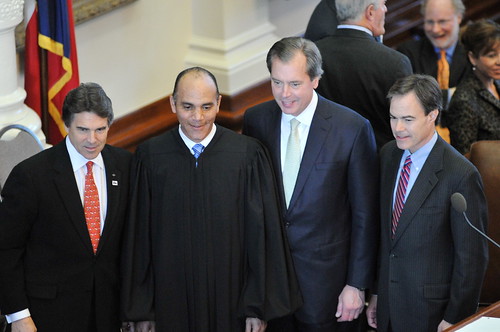
and for something different, here is a group shot of Texas political leadership from earlier this week
Group Shot

Posted in photography | Tagged , , , , , , , | Leave a comment

sink or faucet

are you a sink or faucet? Trevin Wax wants to know.

Hat tip to Justin Taylor.

Posted in church | Leave a comment

Relevance

Joe Thorn has a quote from John Piper regarding relevance that says:

As a preacher, I think a lot about relevance. That is, why should anyone listen to what I have to say? Why should anybody care? Relevance is an ambiguous word. It could mean more than one thing. It might mean that a sermon is relevant if it feels to the listeners that it will make a significant difference in their lives. Or it might mean that a sermon is relevant if it will make a significant difference in their lives whether they feel it or not. That second kind of relevance is what guides my sermons. In other words, I want to say things that are really significant for your life whether you know they are or not. My way of doing that is to stay as close as I can to what God says is important in his word, not what we think is important apart God’s word.

John Piper, What Man Does in the New Birth

here are a couple more bits from later down in John Piper’s sermon:

My job as a spokesman for God week after week is to deal in what matters most, and to stay close to the revealed will of God in the Bible (so you can see it for yourselves), and to pray that, by God’s grace, the young, idealistic, angry Clarence Thomases in the crowd, and everyone else, will see and feel the magnitude of what God says is important.
….
Nothing is more important than the glory of Christ personally seen and savored in the kingdom of God with as many people as we can gather in his name. And it will one day fill the earth with peace and justice as the waters fill the sea. So I hope you don’t leave—for the sake of your soul and the sake of the world.

Now go check out the comments to Joe Thorn’s post. The tug of war is always present, isn’t it?

Posted in church, teaching | Tagged , , , , | Leave a comment